tension test 3


Stress – strain diagram of Copper and copper alloys : -


Examples of the tensile stress-strain curves.
1- Electrolytic copper.
2- Commercial copper.
3- Bronze.
4- Cold worked copper (or cold drawn copper).


Stress – Strain diagrams of some standard steels :

The most important strength and ductility of the commercial steels are given as follows:-


Stress – Strain diagrams of some standard steels

Effect of heat treatment on the properties of steel found in tension test

The effect of heat treatment on the tensile stress-strain curves of the carbon steel is clearly shown fig. shows:-

- The hardened (quenched) steel shows no yield point and the smallest amount of elongation (greatest tensile strength).

- But if this steel is dead annealed a well defined yield point would appear and an appreciable elongation would result.

Stainless steels can be roughly divided according to the chemical compositions and
heat treatment into four groups with similar properties within each group: martensitic and ferritic-martensitic, ferritic, ferritic-austenitic, austenitic. Figure (b) shows the stress-
strain curves of different stainless steels.


Effect of temperature on the tensile properties of steel

Testing of metals by a tension test is usually carried out at room temperature.
For the application of material at higher temperature it is mandatory to test it at
the corresponding temperature. As a rule on raising the temperature at which the test is done the tensile strength decrease and the elongation and R.A. would increase.


Effect of testing velocity (rate of loading) on the tensile properties of metals : -

This effect is nearly obvious by all metals, If the rate of loading is increased, the yield stress and tensile strength would also increase, while the percent elongation and reduction of area decrease.

the normal rate of loading for static tension test is not more 1 kg/mm in one second.
Or in the term of strain rate it is around the 0.001 sec-1 .

Stress-strain diagram of different forms of tensile specimen :-


Tensile test specimens : -
The standard tension specimens have a fixed forms and dimensions. The cross section of which could of a circular, rectangular or other forms


d = test diameter D = head diameter Lo = test length Lc = gauge length:
L = total length

Sudden change in cross section causes stress concentration so that a fillet with certain radius is necessary as transition diameter between the test diameter and the head diameter.
Surface finish: The degree of surface finish is also an important parameter in the
quality of the produced test specimens and controls the results of the test. Grinding of
the specimen using silicon carbide grinding papers with a grade of higher than 600 grit
could be a satisfactory surface finishing tool.

Standardization
Long proportional specimens

Lo = 10 d or Lo = 11.3 Ao

short proportional specimens

Lo = 5 d or Lo = 5.65 Ao

Ao is the initial area of specimen at the test length


n case of flat, quadratic or other shapes we take referred to specimen’s area A0 (A0 = a
. b, where a is the thickness and b is the width of the test length) using the relations:


READ MORE - tension test 3

tensile test 2

the rest of the tensile test 1

Determination of 0.2% proof stress : -

Some metallic substance doesn't show any yield point a tension test e.g. hard steel, non-ferrous metals and alloys. In this case the 0.2% proof stress found instead of the yield point. The 0.2% proof stress is defined as stress by which plastic deformation of 0.2% take place.
and determined by two methods : -

1-By loading and unloading the tension specimen for several times and increasing the
load gradually in each time. The elongation is measured after every unloading until we
have a plastic elongation equals to 0.2%, then the stress corresponding to that strain is
the 0.2 proof stresses.
2-From stress-strain diagram or a part of it:-
From the point representing 0.2% elongation on the ?-axis a straight line is drawn parallel to that representing "Hook's law". The projection of the point intersection "N" of the line with the curve on the ?-axis gives the 0.2 proof stress, as shown in the following figure.


Example of stress-strain curve and the method of calculation of the 0.2 proof stress.


The engineering and real (true) stress–strain diagram

The engineering stress (S) is determined by dividing the applied force (F) by the initial area (Ao) of the specimen:

S=F/Ao

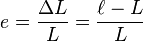
The strain (e) is determined by dividing increase in the length of the specimen (dL in mm) by the original length(Lo) :
e = ΔL / Lo
The real (true) stress (σ) and strain (ε) values are related to the instantaneous cross
sectional area (A) of the specimen and the specimen’s length (L).

True stress: σ = F / A ............................................(1)

True strain: ε = dL / L ............................................(2)

From the volume constancy; AL = Ao Lo ............................(3)

Substituting eq. (3) into eq. (1)

σ = ( F / Ao ) . ( L / Lo )

= S ( ( Δ L+ Lo ) / Lo )

True stress, σ = S (e + 1 )

The true strain is equal to the integration of the incremental stain:
L
ε = ∫ dL/L
Lo

= Ln ( L /Lo)

= Ln ( ( Δ L+ Lo ) / Lo )

= Ln (1 + L / Lo ) )

= Ln (1 + e )

True stress, ε = Ln (1 + e )


READ MORE - tensile test 2

tensile test

A tensile test, also known as tension test, is probably the most fundamental type of mechanical test that can be performed on material to have an idea about the mechanical properties of the materials used in the structural design. Tensile tests are simple, relatively inexpensive, and fully standardized.

The main feature of tension test:

1- Preparation of tension test specimen.
2- The specimen may be of arbitrary cross sectional area depending on the standard used and the shape
of the tested material.
3- The cross section should be constant throughout the test length.
4- Load should increase gradually and axially till the failure occur.

Tension test is the simplest test which used to give an idea about the mechanical properties of the metal used in the structure design as the ferrous and nonferrous metals and alloys.

Data from tension test:

1. The proportionality limit σp

It is the greatest tensile stress at which the stress is proportional to the resulted strain.
The first part of the curve is a straight line which represent "HOOK'S LAW" till the point
P … here the stress is proportional to the strain.
2. The elastic limit (
σE ) :-
It is the greatest tensile stress that a substance can withstand without permanent
(plastic deformation). It is usually difficult to find this experimentally for which reason the 0.01 limit ( σ0.01) and the 0.005 limit considered as the elastic limit. In practice, therefore, the elastic limit is the stress due to which a plastic elongation of 0.01% or 0.005% takes place.


3. The upper yield point ( σyu ) :-
It is the maximum tensile stress at which plastic deformation occurs without increasing
the deforming load. The load will increase with presence deformation in the metal.

4. The lower yield point (σyl ) :-
It is the min. tensile stress at which plastic deformation takes place without increasing of
load. It is explained by the presence of certain concentration of solute atoms of carbon
or nitrogen on the slip planes overcoming the resistance of glide on these plaines lead
to the presence of the higher and the lower yield points.

5. The tensile strength or ultimate strength σUTS :-
It is the greatest tensile strength without breaking the tensile strength: Ultimate strength

σUTS= p max/ A
This is represented on the curve by the point B, at this point a necking, and latter a break of the specimen at some points on it takes place.


Loading up to the peak load (or ultimate tensile stress) the resulting elongation is uniform on the whole specimen length. After this point some instability features like forming of cracks, voids and other damage feature lead to concentrating the deformation in the region where the fracture will take place.


6. The break stress ( σB ) :-
It represents the stress at which the specimen breaks.
σB usually it is less practical than the tensile strength σUTS .
in the design of any structure neither the ultimate stress nor the brack stress would be taken into consideration. It is the yield stress with a safety factor that is near 1.5 to avoid the failure of the construction. Beside the above determined data from the tension test, the value of elongation and reduction of area estimated in a tension test are of great practical importance.

7. The elongation or percent elongation :-
It is a measure of the ductility or formability of metal and is represented by the given formula:


8-Ductile materials such as low carbon steel, copper, and many aluminum alloys reach higher value of elongation with cup and cone fracture. While brittle materials such cast iron, hardened steel alloy and magnesium alloys break at low degree of elongation with cleavage fracture.

9. The reduction of area
is a measure of the ductility of the metal and is given in percent.

"R.A.": usually refers to the total reduction of the area before failure and if a neck is formed, the value of R.A. is determined by measuring the cross sectional area at the point where break occurs.


10. The toughness of a metal :-
The area under the stress-strain diagram is taken as a measure for the toughness of a metal.


11. The resilience of a metal :-
The area under (0, E) curve line is the resilience of the metal and could be defined as the work done by an elastic body to return to its initial shape.
Materials with high resilience are used to products subjected to different sudden loads such as spring material.


READ MORE - tensile test

introduction of testing

Metals testing is very important to show the various properties of metals and the defects
which may found in it during production or during its service.

Classification of metals testing:

1- Destructive tests.
2- Non-destructive tests.
3- Technological tests.
4- Chemical tests.
5- Electrochemical test (Corrosion test).
6- Metallographic tests.


In the following the different classes of material tests will be discussed briefly.

1- Destructive tests.

Destructive material tests are the kind of tests where the test specimen destroys after
the test and could not be used. The test specimens for destructive tests can be a
sample taken out from

- a piece of a semi-product (sheet, rod, section).
- a sample of the final products (bolts, shafts), or any simple structure.
Destructive tests are:-
1. Tensile test
2. Compression test
3. Bending test
4. Impact test
5. Creep test, and stress relaxation test.
6. Fatigue test

2-Non-destructive materials test
They are tests that carry out on specimens of material products or on specimens of
machine parts or structure during the service without changing their functions to find out
their defects. The following tests are classified as non-destructive tests :-

1- Radio graphic test
2- Magnetic test
3- Electrical test
4- Ultra-sonic test
5- Some hardness test

3-The technological test
It is usually rapid methods, which give an idea whether metal is suitable for a special purpose or
not, e.g. testing a metal to know its liability to forging, rolling, bending or deep drawing.
Technological test such as:-

1- Spark test

Some metal can be estimated by spark test wherever some metal give spark (Fe) and
the other (Mo) not.
The spark density, color and it’s shape can also define the type of metal under the
testing.

2- Worm compression test

The shape and distribution of the cracks on carrying out a warm compression gives an
indication about the type and properties of the metal.

3- Bending test

Bending of sheets for several times, it gives an indication for the ability of deep
drawing of metal under testing.

5- Folding test

by folding the sheet to show its ability of forming.

6- Hammering test

from the sound of hammer or the deformation resulting from the
hammering, some indications could be obtained about the metal.

Technological tests do not give a quantitative result, but give an idea about the different
properties of the metals or its stability for the working purposes.

4- Chemical tests

Chemical analysis is carried out on the metals and alloys for the following purposes:
- To identify the quantity and types of the inclusions (sulphides, oxides).
- To show the percentage of the alloying elements.

5- Electrochemical test

The well known electrochemical test is the corrosion test, to show the activity of the
metals and alloys in different environments; i.e. in different chemical medium and under
different current density. Other electrochemical experimental tests are the metal wining
test (such as copper refining) and metal plating.


6- Metallographic test

It is the study of microstructure of the specimen on the prepared cross section under an
optical microscope (up to a magnification of 2000X) or studying the macrostructure
under low magnification stereomicroscope (up to 20X).
The purposes of metallographic are:-

1- Structure of phases; i.e. shape and distribution of graphite in grey cast iron,
cementite in white cast iron and distribution and area fraction of reinforcing
component in composite materials.
2- Density and length of micro-cracks.
3- Grain size of the micro- and macrostructure.
4- Type and morphology of the inclusions.

5- The form and distortion of the grain gives an indication about the type of deformation
(rolling, bending).
6- Identification of the type of stress leading to the failure of the damaged materials
(creep failure, fatigue, stress corrosion cracking, …).

Classification of materials testing depending on the rate of loading:


Metals testing are carried out under a very wide range of strain rates ε/dt) ranging between

between 10 sec .

Static and very slow rate tests:-


Such as creep tests which prolonged over a very long time (up to 10 years)

Quasi-static tests:-

It is the region of loading range where most traditional tests such as tensile test,
compression test and bending test are carried out. This range lying around a strain rate
range of 0.001 sec ¯¹.

Higher strain rate deformation:-

It is the range of testing that occurs at the strain rate range between 0.1 and 100 sec¯¹ .
This strain rate range covers the usual rolling forging and drawing processes.

High strain rate and crash tests:-

It is the range of testing simulating the high strain rate deformation and the deformation
occurring at the crash conditions. At these conditions impact test and crash test are
usually carried out where the strain rate is more than 100 sec¯¹ .


READ MORE - introduction of testing


Followers